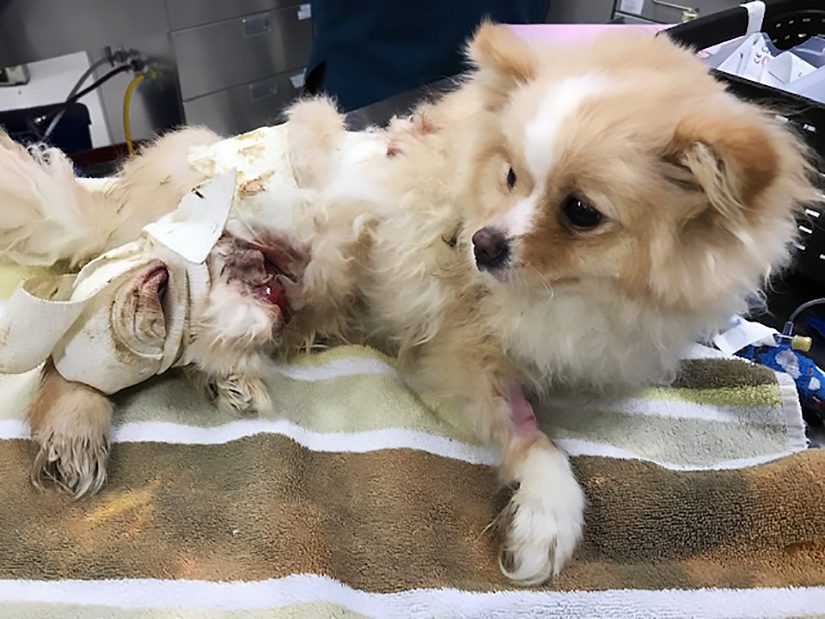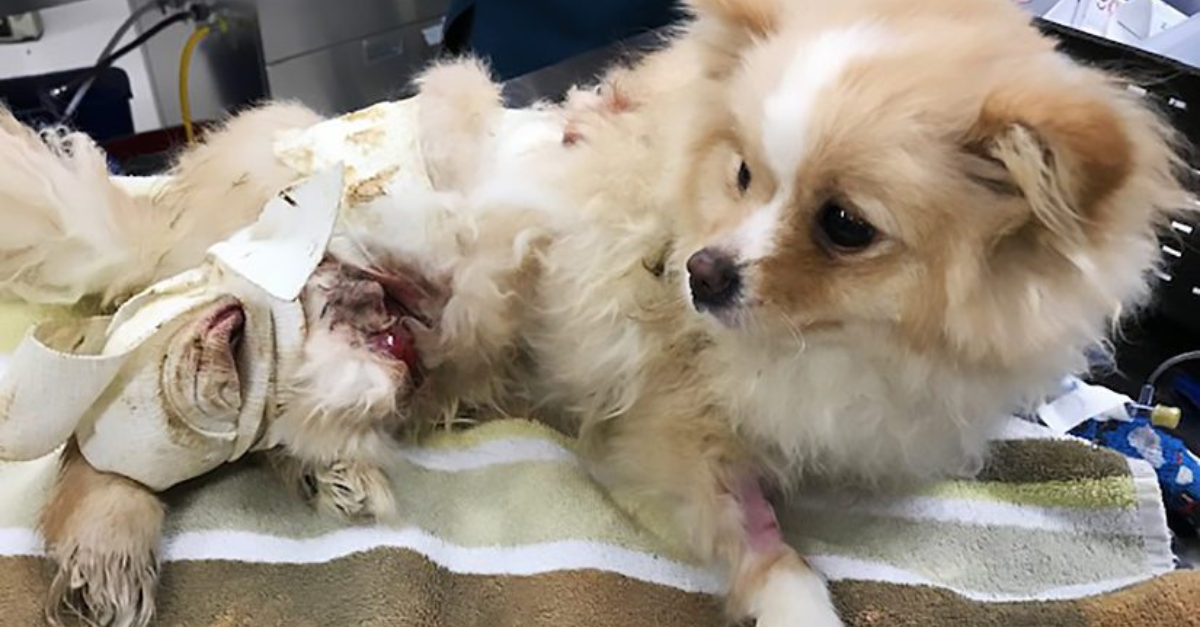
The dog lay on a thick towel in the treatment room, her body curled in a way that suggested she was trying to protect the most painful parts of herself.
Bandages covered her injured leg and part of her torso. Beneath them, the wounds told a story no animal should ever carry: repeated trauma, untreated pain, and injuries that had been allowed to worsen over time. Her fur was patchy, matted in places, and her skin showed signs of old bruising and fresh inflammation.
The staff named her Luna.
She had been removed from a property after neighbors reported distressing sounds and a pattern of neglect that had escalated over time. When rescuers arrived, Luna did not run toward them. She did not run away either.
She simply froze.
As if she had learned that movement itself could bring consequences.
The first time a hand reached toward her, Luna flinched so hard her injured leg shook. She tried to press herself into the corner of her enclosure, breathing fast, eyes wide with anticipation of something painful.
No one raised their voice.
No one touched her harshly.
But her body did not yet understand that.
At the clinic, the veterinarian worked carefully to stabilize her condition. Some of her injuries were clearly older, partially healed in the wrong way. Others were newer, still sensitive and reactive to the slightest pressure.
Each time the bandages were adjusted, Luna tensed as if preparing for impact.
A nurse stayed beside her the entire time.
Not forcing contact. Not rushing her.
Just present.
“Nothing here will hurt you anymore,” she said quietly, though Luna could only understand tone, not words.
Slowly, something began to shift in the small dog’s behavior.
Not trust yet.
Something more fragile than that.
A pause in fear.
When the room was quiet, Luna stopped trying to disappear into the towel. Her breathing evened out slightly. Her eyes no longer darted toward every movement.
But whenever a hand came too close too quickly, the instinct returned instantly — a sharp, learned reaction shaped by something she had not chosen to endure.
That night, she was given a soft bed and a space away from noise.
She did not sleep deeply.
Every sound made her lift her head.
Every footstep made her body tighten.
But there were no blows. No shouting. No rough hands.
Only silence, medicine, and people who stayed nearby without asking anything from her.
Hours passed before Luna finally lowered her head fully onto the blanket.
Not because she felt safe.
But because exhaustion briefly outweighed fear.
The abuse had left marks on her body, but it had left something deeper in her behavior — a constant expectation that pain could return at any moment.
And yet, for the first time since she was found, that expectation was not confirmed.
No one came to hurt her.
No one came to make her flinch.
Only people who returned again and again with steady hands, learning how to exist in her world without breaking what was already fragile.
Luna was still healing.
But for the first time, her body was beginning to learn a new possibility:
that not every hand reaching toward her would be one to fear.