For weeks, people living near the old repair shop heard a chain scraping across concrete after dark.
The sound came from a hidden yard behind tall metal fencing. Sometimes it was followed by a faint whimper, but whenever anyone questioned the owner, he gave the same warning.
“The dog is dangerous. Stay away.”
So everyone did.
Until one gray morning, a delivery driver named Emily Carter heard something different behind the fence.
It was not barking.
It was the broken, rapid breathing of an animal struggling to remain standing.
Emily stopped her van and looked through a narrow gap in the metal panels.
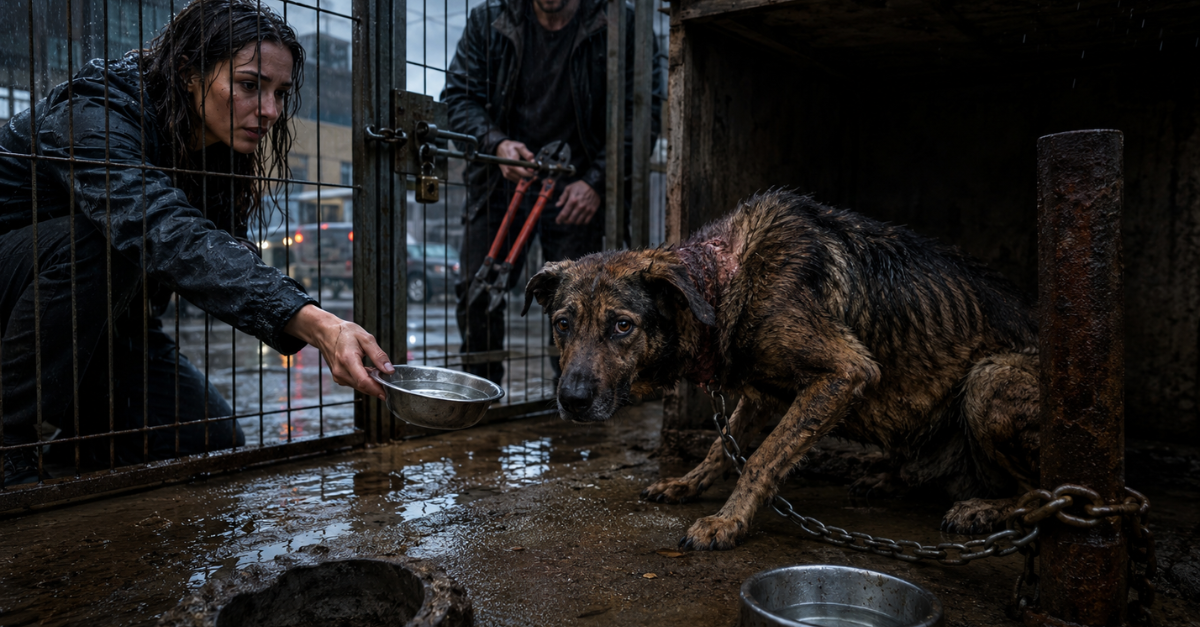
A large shepherd mix was chained to a rusted post. His brown-and-black coat was filthy and soaked. His ribs showed beneath his skin, one ear hung low, and his front leg trembled whenever he shifted his weight.
Around his neck was a wide strip of raw, hairless skin where the collar and chain had rubbed against him for far too long.
The chain was so short that he could not reach the covered section of the yard.
His food bowl was empty.
His water bowl had overturned.
The dog was licking rainwater from a shallow crack in the concrete.
Emily poured water through the gap and into the dented bowl.
The moment he saw her hand, the dog bared his teeth and threw himself backward. The chain snapped tight around his injured neck, and his body folded in panic.
Emily froze.
She did not pull the bottle away.
She simply placed it down and stepped back.
The dog watched her, trapped between terror and thirst.
After several minutes, he lowered his body and crawled toward the bowl. He drank desperately, but his eyes never left Emily’s hand, as though he expected it to strike him the moment he came close.
Emily understood then.
He was not dangerous.
He was terrified.
That afternoon, she returned with Daniel Brooks, a local animal rescuer. They began calling the dog Ranger.
Daniel immediately noticed the short chain, the damaged neck and the way Ranger avoided placing weight on his front leg. But the most disturbing moment came when the owner stepped into the yard.
At the sound of his voice, Ranger pressed himself against the post.
His ears flattened.
His head dropped.
His entire body began to shake.
The owner insisted Ranger was only a guard dog.
“He belongs to me,” he said. “You have no right to take him.”
Daniel looked through the fence at the trembling animal.
“A difficult dog may bark or defend its space,” he replied. “This dog is trying to disappear.”
The owner refused to let them enter. Daniel contacted animal-control officers and a veterinarian, but they had to wait for authorization before removing Ranger.
Then the rain began.
Within minutes, water poured across the yard. Ranger tried to crawl beneath the small roof, but the chain stopped him several feet short. He could only lie on the exposed concrete while rain soaked through his coat.
Emily pushed part of her jacket through the gap to shield him.
Ranger stared at her.
Slowly, he moved one dirty paw toward the fence. It stopped close to her fingers, separated from them by cold metal.
It was not trust.
Not yet.
It was the weakest kind of plea from an animal that had never learned how to ask for help.
Then the owner returned with a large padlock.
He slammed the gate shut and ordered everyone to leave.
The sound made Ranger recoil. He dragged his paw away and curled against the ground.
Before leaving to meet the officers, Daniel crouched beside the fence.
“We’re coming back, Ranger,” he promised.
The dog remained facing the gate long after their vehicle disappeared.
Emily stayed nearby as darkness fell. She could not bear the thought of Ranger believing everyone had left him again. She sat outside the fence in the rain, speaking his new name softly.
He did not approach.
He only listened.
Nearly an hour later, headlights appeared at the end of the alley.
Daniel had returned with an animal-control officer and a veterinarian.
The owner stood in front of the locked gate and refused to move. He shouted that Ranger was private property and that no one had permission to touch him.
Behind the fence, the raised voices sent Ranger into panic. He tried to stand, but his injured leg gave way beneath him.
Daniel moved closer to the gap.
“Ranger,” he called. “We came back.”
The dog slowly lifted his head.
His body was still shaking, but this time he did not turn toward the wall.
He looked directly at the people outside.
The veterinarian warned that Ranger appeared severely dehydrated and might have an infected neck wound. Waiting much longer could place his life at greater risk.
An officer examined the gate.
Daniel raised a heavy bolt cutter toward the padlock.
The owner stepped forward, still protesting.
On the other side, Ranger attempted to stand again.
Between him and the rescuers remained one locked gate—and a question that divided everyone watching:
When an animal is clearly suffering, should ownership still come before its safety?
Or should someone cut the lock before the law arrives too late?
The jaws of the bolt cutter closed around the metal.
Ranger stared through the fence.
And for the first time, he seemed to understand that the people outside were no longer planning to walk away.